
Skip to the content
Porsche

1954 Porsche 356
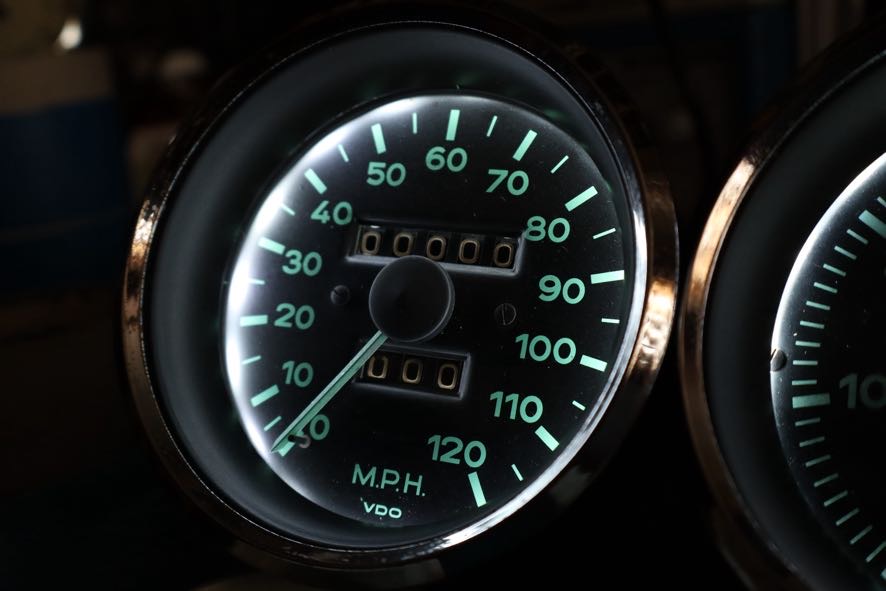
Speedometer lit from behind in the dashboard, green numerals reading to 120 mph, VDO on the dial, a second gauge alongside.

A four gauge restoration, from a set that arrived with every instrument either dead or failing.

What Arrived

A complete set of four instruments, all of them dead or failing: the speedometer, the tachometer, the Kraftstoff fuel gauge, and the dual Celsius and Fahrenheit Störk oil temperature gauge.

The faces had gone the way early 356 faces do. The black screening breaks down over the decades and the Porsche green beneath it begins to crack through across the whole dial. All four had reached that point.

Mechanically, each one had its own fault. The speedometer’s odometer was not turning and its wheels had settled at different positions. The tachometer squealed. Neither the fuel gauge nor the oil temperature gauge worked at all.

The owner also asked for two changes: the fuel gauge converted to electronic, which it never was originally, and the same for the oil temperature gauge.

The Cosmetic Work

Every gauge came apart completely, with each component boxed into its own place so nothing could be lost or confused between instruments.

The faces were blasted, painted black, and the artwork screened back on top. Each pointer was stripped and repainted, green on the pointer itself and black on the hub, as it left the factory. The cases were blasted.

Then the mechanical work began.

What Made This One Difficult

The Odometer Wheels

The odometer wheels and star gears were broken. Star gears are straightforward to replace. The wheels are not: they are very hard to find, and these use a specific font that will not be matched by something off another car. Repairing and cleaning the originals was the only honest route, and it was the most important part of the job.

The Tachometer

The frame and the hairspring had swung wildly and broken. Working back from the damage: at some point the tachometer cable pushed up into the magnet shaft. That shaft sits inside a speed cup, and the pointer is connected to the cup. Once the shaft was forced up into it, the cup gripped as it spun and took the hairspring and the pointer with it. A new pointer had to be found or made.

New bushings went into both the speedometer and the tachometer.

The Two Conversions

For both the Kraftstoff fuel gauge and the Störk oil temperature gauge, a new movement had to be made to fit inside the original case, the point being that the instrument still looks exactly as it should from the front.

What Went Back

All four gauges with new hardware, new senders, and a new chrome bezel on each: fully functional, correct to look at, and ready to be driven for years rather than displayed.